


This week, I encountered a Tweet that stopped my scroll:
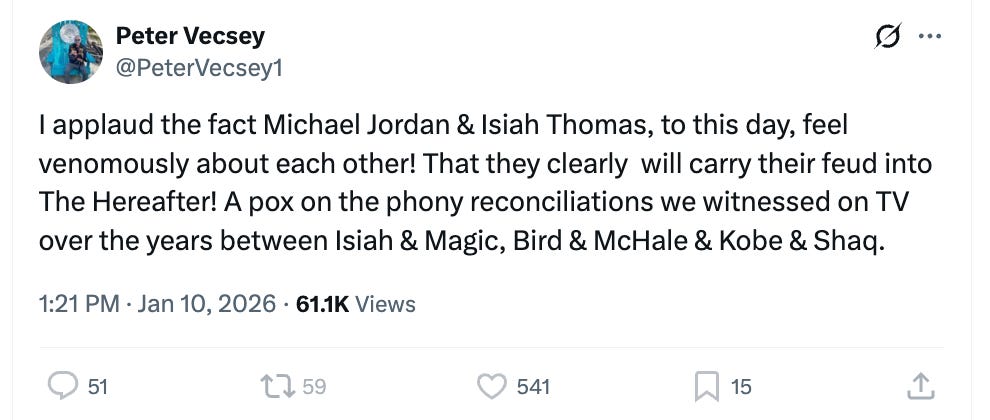
It wasn’t the content that surprised me so much as the author.
Peter Vecsey is a former pro basketball reporter and one of the most acidic personalities I’ve ever encountered. He is retired now, but as a columnist, he embodied the New York Post’s approach to … well … everything.
I was surprised to see ANYTHING from Vecsey for reasons I’ll eventually get to.
But after the shock of seeing his words, I felt a tinge of recognition.
His words were exactly the kind of thing I might have said five or six years ago because back then, I felt a respect perhaps even admiration for people who were willing to hold onto their anger over some past slight they’d suffered.
I saw it as a sign of strength.
I no longer feel this way, though, and at a personal level, I’m a lot happier because of that. Before I get to that, though, let’s talk about the grudge in question.
😡 Thirty-five years of animosity 😡
Michael Jordan and Isaiah Thomas are two of the very best basketball players of their generation.
Thomas is from Chicago, and he won two championships with the Detroit Pistons. Jordan is from North Carolina, but he played professionally in Chicago where he won six titles with the Bulls. Many people (including me) consider MJ to be the best player ever.
There has been serious tension between the two of them for much of that generation.
More specifically, Jordan harbored a grudge against Thomas, and while he doesn’t usually spell it out this explicitly, most people who closely follow the NBA understand that it relates (primarily) to two things:
In 1985, Jordan was frozen out in the All-Star Game as a rookie;
In 1991, Thomas and his Pistons walked off the floor without shaking hands with Jordan and the Bulls after Chicago won the Eastern Conference championship.
There has always been a bit of an urban legend that these two incidents caused Jordan to conspire to have Thomas omitted from the 1992 Olympics, the so-called Dream Team.
Thomas, for his part, has denied the All-Star freezeout ever occurred. As for walking off the floor, Thomas said that’s what the Celtics had done to the Pistons several years earlier.
Up until five years ago, Thomas professed ignorance of Jordan’s (fairly obvious) disdain. That became impossible after the multi-part documentary “The Last Dance” in which Jordan called Thomas an (orifice) and discussed the Thomas’ Olympic omission. Jordan said, quite specifically, he never asked Thomas be left off let alone insisted on it.
At this point, I think it’s fair to say they’re mortal enemies though it’s worth noting two things about this:
He’s certainly not the first star basketball player to deeply dislike Thomas.
🧠 Let’s think about it 🧠
Here are two men in their 60s who are among the best to ever play pro basketball. Both have close ties to Chicago, and they are still at odds over things that were done 35 years ago.
Five years ago … there was part of me that felt this is exactly how real men handle things. You cross a line, there are consequences and those consequences don’t dissipate over time.
Jordan didn’t pretend that he and Isiah were friends. He didn’t offer bland compliments or present a façade of peace. He had nothing to do with Thomas and didn’t appear to be concerned with what Thomas might do or say about him.
Doesn’t mean you have to fight. We’re certainly past dueling with pistols at dawn, but I believed it fine to decide, “I hate that dude,” grit your teeth and mean it forever.
Some of this … no … a lot of this was tied up in my own unresolved anger toward my stepfather.
I was still mad not so much at what he’d done, but my belief he’d remained totally unaccountable for what he’d done. When I’d asked to have a conversation about what had occurred within our family, he ignored me. He never acknowledged to me, let alone apologized, for the things that happened and as a result I had no intention of letting go of that anger.
That’s how a man handles things, I thought.
In fact, it is how men often handle it, but I don’t think that’s a compliment.
Where does that get you?
That’s not a rhetorical question. What is the result of holding onto resentment, maintaining not just a cognizance of past slights but a ferocity over them?
💣 Tick, tick, tick 💣
My willingness to hold on to my anger resulted in an increasing collection of petty feuds and legitimate beefs.
A radio host at a rival station insulted my wife on Twitter after a column of hers was published in The Seattle Times.
In the early days of the pandemic, a troll began to target not just me, but my co-workers on the radio show I hosted. I was deeply bothered by his harassment.
Beneath all of that was the enduring hostility I harbored against my stepfather. It provided something of a template for how I dealt with my anger or more accurately failed to deal with it.
At the core of all these grudges was a desire to do something that would cause these people to regret what they’d done to me and/or the people I loved.
I also knew that seeking revenge in that way is seen as immature and picking fights is also known as “assault.” I decided I was just going to hold onto my anger, occasionally stoking the embers by thinking about what that person had done.
It was an increasingly unpleasant way to live and over the past few years — with the help of a therapist — I’ve come to understand the power of acceptance. It’s a useful tool that’s allowed me to move past the pain I experienced even when the person who I blame for causing that pain refused to acknowledge what he’d done.
That doesn’t mean you have to forgive. It certainly doesn’t mean you should forget, but it does provide a way to dilute the pain caused by a specific person or event.
That brings me back to that Tweet that started this whole train of thought.
🔑 Unlocking animosity 🔑
I have no idea how much time or energy Michael Jordan and Isiah Thomas spend prosecuting their feud. I don’t know how much (if any pain) they feel over it.
For all I know, it could be a source of meaning in their respective lives.
I do know that approach made me increasingly angry and more volatile, and when I look at their feud, I see two men who remain hung up on past slights, both real and imagined.
As for Peter Vecsey, the journalist whose Tweet I was surprised to see. I never met him though I did see him at several NBA games back when I was covering the Seattle Supersonics from 2002 to 2005. He was unmistakable in his suits and close-cropped beard.
The reason I was surprised to see his Tweet is not just because he’s retired. You see, he blocked on Twitter several years ago, which in fairness to him, was not entirely unwarranted.
I had responded to something he posted by referencing an incident that had occurred in Seattle back in 1996 when he was charged with fourth-degree assault for striking a man at a Toys R Us. Seriously: that happened.
That was back when I still thought feuds were a sign of strength, though, and while I’m not going to say that I was wrong for bringing this up in the way I did, I will say that I’ve been working to become less cantankerous over these past few years and will continue to do so.
Bird & McHale?
I do wonder what happened to Hall & Oats so late in their life.
This is really valuable, helpful writing. Thank you, Danny.